
Design for the outage: offline resilience is a buying criterion, not a feature
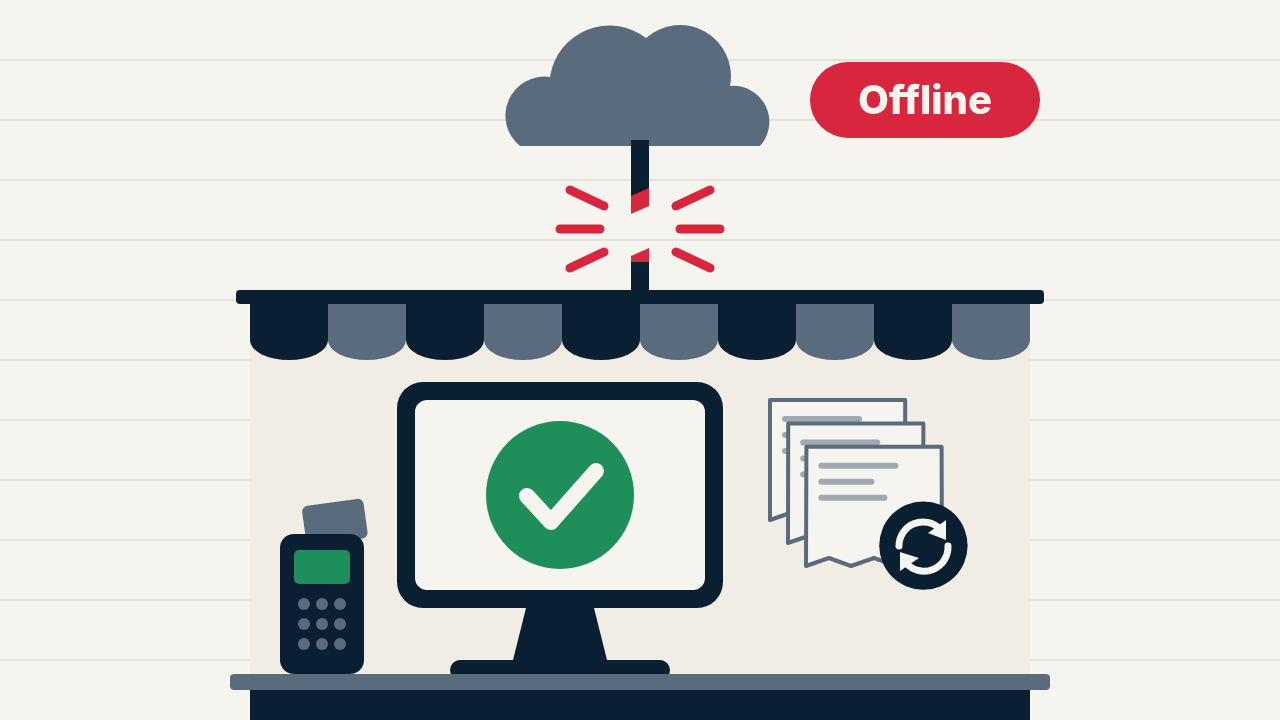
Cloud POS made checkout easier to buy and harder to break in one place. It also made the merchant's ability to take money depend on networks and vendors they do not control. Buyers should evaluate failure modes with the same rigor as features.
The argument in brief
- Outages are not hypothetical: since 2023, a single vendor’s infrastructure fault has stopped checkout for large numbers of businesses, and a single security vendor’s bad update crashed an estimated 8.5 million Windows devices.
- “Offline mode” is not one thing. Vendor documentation shows hard limits on time, tender types, and who carries the risk of payments accepted offline.
- Buyers should ask for a written failure-mode profile — what works, for how long, at whose risk — and weigh it alongside price and features.
Two outages, two different lessons
On September 7, 2023, Square products and services became unavailable starting at 1:54 p.m. ET. According to Square’s own incident summary, systems began to recover at 2:05 a.m. ET the next day and the incident was resolved at 5:19 a.m. ET; Square attributed the outage to “an unrelated change to our host-based firewalls combined with a DNS service upgrade” that overloaded internal DNS servers, and said it had ruled out a cyberattack.1 NBC News reported on small businesses that lost sales during the outage, including Adam Blackbill, who operates Urban Churn, an ice-cream business in central Pennsylvania. Blackbill estimated $8,000–$10,000 in lost revenue (his estimate, not an audited figure) and said offline mode worked at two of his three stores, though about 30 of those offline transactions appeared to be missing as of the following morning, NBC reported.3 Square’s incident summary says it “deferred processing offline payments for a number of hours” and completed processing uploaded offline payments by 1:57 p.m. ET on September 8, or shortly after a device came online later.1
The lesson most people took was “the cloud went down.” The more useful lesson is in Square’s own remediation list: it said it was “expanding support for and improving our communication regarding the availability of Offline Mode.”1 Square’s current documentation says offline payments are now enabled by default on all devices unless a seller opts out (since April 2026).2 In other words, a capability that existed was not available, configured, or understood everywhere it was needed.
Ten months later, on July 19, 2024 (04:09 UTC; the evening of July 18 in the U.S.), a faulty CrowdStrike content update crashed Windows systems worldwide.4, 12 Microsoft estimated that 8.5 million Windows devices were affected — “less than one percent of all Windows machines” — and noted that the broad economic impact reflected use of CrowdStrike by enterprises that run critical services.4 CISA, relaying CrowdStrike’s confirmation, said the outage affected Windows 10 and later systems, not Mac or Linux hosts, and was not caused by malicious cyber activity.5
That incident had nothing to do with any POS vendor’s cloud. The failure arrived through the endpoint — the operating system and security software on the device itself. A cloud-first architecture would not have protected a Windows-based lane; neither would a well-designed offline mode, because the device could not boot. The sources cited here document a widespread Windows outage; they do not, by themselves, document how many point-of-sale lanes were among the affected devices.
Together, the two incidents show that resilience has at least three layers: the vendor’s cloud, the store’s network, and the device stack. A buyer who asks only “do you have offline mode?” is evaluating one layer.
What “offline mode” actually means — in the vendors’ own words
Vendor documentation is candid about limits, and that is where buyers should start. The platforms below are included because each publishes official offline-payment terms (and, in Square’s case, a public incident summary). They are examples, not a ranked list.
Square (vendor documentation, accessed 2026-11-16): offline payments are processed automatically when the device reconnects “within 24 hours (no later than 72 hours).” Some hardware configurations — Square Reader for contactless and chip, and Square Stand — can only accept offline payments for 24 hours at a time. Pending payments expire after 72 hours and “cannot be retrieved or reprocessed.” Several payment types are excluded offline, including Tap to Pay on iPhone and Android, manually entered cards, EBT/SNAP, Square Gift Cards, Afterpay and Cash App Pay. Square states: “You’re responsible for any expired, declined, or disputed payments accepted while taking offline payments.” Merchants can set a per-transaction offline maximum between $1 and $50,000.2
Toast (vendor documentation, accessed 2026-11-16): offline card data is encrypted and stored on the device, then sent for authorization when the device is back online. Toast says the restaurant is “responsible for any declined, expired, or disputed payments while operating in offline mode,” recommends that tablets that have taken offline payments return online “within three days, preferably within 24 hours,” and offers a transaction limit above which manager approval is required. Card pre-authorization is not available offline.6
Clover (vendor documentation, accessed 2026-11-16): Clover’s developer documentation says that by default, Clover Mini and Flex are set to take offline payments for up to seven days. Merchants can disable offline payments if they don’t want to accept the associated risk, or they can set limits on the amount of each offline payment and on the total amount processed while offline.8
Shift4 Dine (vendor documentation, accessed 2026-11-16; Shift4 renamed SkyTab POS to Shift4 Dine on May 12, 2026):9 offline processing stores transactions on the device until the connection is re-established, then sends them for authorization. Shift4’s knowledge base says transactions can be stored for up to two days; refunds and pre-authorizations are unavailable while offline; all PIN pads attached to the terminal can take offline payments, but Shift4 Duo devices do not support them. Digital wallets such as Apple Pay and Google Pay work in Offline Mode, according to the same documentation.10
Lightspeed Retail (X-Series) (vendor documentation, accessed 2026-11-16): Lightspeed Payments offline mode is, according to Lightspeed, “currently in beta and may not be available in your account or area,” and is only available with the Smart Terminal (WisePOS E). Supported card entry is tap or dip for Visa, Mastercard, Discover and American Express; Interac is not supported in Canada. Payments taken in offline mode “are not linked to a sales record.” Lightspeed states that by enabling offline mode, “you accept responsibility for any expired or declined transactions taken while offline or any resulting chargebacks, in accordance with your platform payment agreement.” Merchants can set per-transaction and total transaction limits at or below pre-filled maxima.11
Across these platforms, the same structure recurs: offline acceptance is a merchant-borne credit risk with a clock on it, and some tender types, devices or features simply stop working. The clocks and exclusions differ — Clover’s documented default window is up to seven days; Square’s stored payments expire after 72 hours; Shift4 Dine documents storage for up to two days; Lightspeed’s retail offline payments are standalone and currently described as beta. That is not a criticism of any vendor — it reflects how card authorization works — but it means “offline capable” on a comparison grid is close to meaningless without the details. Square’s documentation supports that reading: “Payment card industry partners and regulators set specific requirements related to the duration of offline payment sessions.”2
The tradeoff buyers are actually making
| Design choice | What you gain | What you give up |
|---|---|---|
| Pure cloud, online-only | Simplest operations; always-current data | Checkout stops when the network or vendor does |
| Cloud + device-level store-and-forward (e.g., Square, Toast; see their documentation) | Keep selling through short outages | Merchant carries decline/expiry/dispute risk; some tenders unavailable; time limits |
| Cloud + local edge/server (an approach some enterprise grocery and retail platforms use) | Longer and richer offline operation (prices, promotions, inventory lookups) | More hardware to manage, patch and secure — the CrowdStrike-type risk moves into the store |
| Multiple acceptance paths (e.g., a backup terminal on a different processor or network) | Survives a single-vendor outage | Cost, reconciliation complexity, and contract terms that may restrict it |
There is no universally right answer. A coffee bar with a $6 average ticket can rationally accept offline risk; a furniture retailer with $3,000 tickets probably should not, or should cap it tightly. A grocer whose customers rely on EBT needs to know that some platforms exclude EBT from offline acceptance — Square’s documentation lists EBT/SNAP among unavailable offline payment types.2
What to ask before you sign
- Failure-mode profile, in writing: What works when (a) the store internet fails, (b) your cloud fails, (c) the device OS or security agent fails? For how long?
- Tender coverage offline: Which payment types are unavailable offline (contactless phone acceptance, manual entry, gift cards, EBT, BNPL, loyalty redemption)?
- Risk allocation: Who bears declined, expired, or disputed offline payments? What offline caps can we set per transaction and per device?
- Time limits: How long can a device accept offline, and when do stored payments expire?
- Data during an outage: Do online orders, delivery tickets, timeclock and kitchen routing keep working? (Square notes some online orders won’t appear in the POS during certain disruptions.)2
- Communication: Where is the status page, and how are merchants notified? (Square committed to faster communication after 2023.)1, 7
- Endpoint resilience: For Windows/Android/iOS lanes, how are OS and security-agent updates staged? Can we roll back?
- Contract remedies: Are there service credits or SLAs, and do they cover payment acceptance or only software uptime?
Where this argument does not apply
Very small sellers who take mostly cash, or businesses with a single low-value transaction type, may rationally choose the simplest online-only setup. And no amount of buyer diligence removes the core constraint that card authorization requires reaching the issuer; offline modes manage risk, they do not eliminate it.
What this means
Treat resilience as a scored requirement in every POS evaluation — a line in the RFP, not a checkbox. Ask every shortlisted vendor for a written failure-mode profile: a short account of what still works when the store internet, the vendor’s cloud, or the device itself fails; for how long; which payment types and features drop out; and who bears declined, expired or disputed payments. Where the vendor has not documented a point, the profile should say “unknown.”
The documentation already cited shows why that level of detail is the useful unit, and why a yes/no “offline capable” box is not:
- Time limits differ. Square says stored payments expire after 72 hours, and some hardware (Square Reader and Square Stand) can only accept offline payments for 24 hours at a time.2 Toast “strongly recommends tablets that have taken offline payments return online within three days, preferably within 24 hours.”6 Clover’s developer documentation says Mini and Flex default to as much as seven days.8 Shift4 Dine documents storage for up to two days.10
- Liability is assigned in writing, usually to the merchant. Square states: “You’re responsible for any expired, declined, or disputed payments accepted while taking offline payments.”2 Toast says the restaurant is “responsible for any declined, expired, or disputed payments while operating in offline mode.”6 Lightspeed says that by enabling offline mode, “you accept responsibility for any expired or declined transactions taken while offline or any resulting chargebacks.”11
- Coverage is uneven across devices and tenders. Square excludes EBT/SNAP, Tap to Pay, gift cards, Afterpay, Cash App Pay and manually entered cards from offline acceptance.2 Toast and Shift4 Dine say pre-authorization is unavailable offline; Shift4 Duo devices do not support offline payments at all.6, 10 Lightspeed’s retail offline payments are standalone (not linked to a sales record), currently described as beta, and available only on the Smart Terminal (WisePOS E).11
A buyer who scores those four questions — what fails, for how long, what limits apply, and who bears the liability — can compare platforms. A buyer who only asks whether offline mode exists cannot.
Sources
- Square Engineering, The Corner (Square Developer blog), “Incident Summary: 2023-09-07,” Sept. 15, 2023. https://developer.squareup.com/blog/incident-summary-2023-09-07/ (vendor statement)
- Square Support Center (US), “Process offline payments.” https://squareup.com/help/us/en/article/7777-process-card-payments-with-offline-mode (vendor documentation; accessed 2026-11-16)
- Marley Jay, NBC News, “Square outage costs small business owners thousands in lost revenue,” Sept. 8, 2023. https://www.nbcnews.com/business/consumer/square-outage-costs-small-business-owners-thousands-lost-revenue-rcna103504 (independent reporting)
- David Weston, VP Enterprise and OS Security, Microsoft Official Blog, “Helping our customers through the CrowdStrike outage,” July 20, 2024. https://blogs.microsoft.com/blog/2024/07/20/helping-our-customers-through-the-crowdstrike-outage/
- CISA, “Widespread IT Outage Due to CrowdStrike Update.” https://www.cisa.gov/news-events/alerts/2024/07/19/widespread-it-outage-due-crowdstrike-update (government)
- Toast Platform Guide, “Offline card payments.” https://doc.toasttab.com/doc/platformguide/adminOfflineCCPayments.html (vendor documentation; accessed 2026-11-16)
- Square, “An update on last week’s outage,” Sept. 11, 2023. https://squareup.com/us/en/press/an-update-on-last-weeks-outage (vendor statement)
- Clover Docs, “Handle offline payments.” https://docs.clover.com/dev/docs/handling-offline-payments (vendor documentation; accessed 2026-11-16)
- Shift4, “Welcome to Shift4 Dine,” May 12, 2026. https://releasenotes.shift4.com/announcements/ann_yhCPuIWjwIWJt (vendor announcement)
- Shift4 Knowledge, “Shift4 Dine Offline Payments Overview and FAQs,” updated Sept. 4, 2026. https://shift4.zendesk.com/hc/en-us/articles/4416200518931-Shift4-Dine-Offline-Payments-Overview-and-FAQs (vendor documentation; accessed 2026-11-16)
- Lightspeed Retail (X-Series) support, “Lightspeed Payments offline mode with Retail POS (X-Series).” https://x-series-support.lightspeedhq.com/hc/en-us/articles/25533690950427-Lightspeed-Payments-offline-mode-with-Retail-POS-X-Series (vendor documentation; accessed 2026-11-16)
- CrowdStrike, “Remediation and Guidance Hub: Channel File 291 Incident.” https://www.crowdstrike.com/falcon-content-update-remediation-and-guidance-hub/ (vendor statement; rollback guidance cites 2024-07-19 0409 UTC)