
The real price of “free” POS is the processing contract
A $0 software plan is a financing arrangement, not a discount. Buyers should price the whole contract — processing rate, hardware terms, add-ons and exit costs — over its full term before they compare monthly fees.
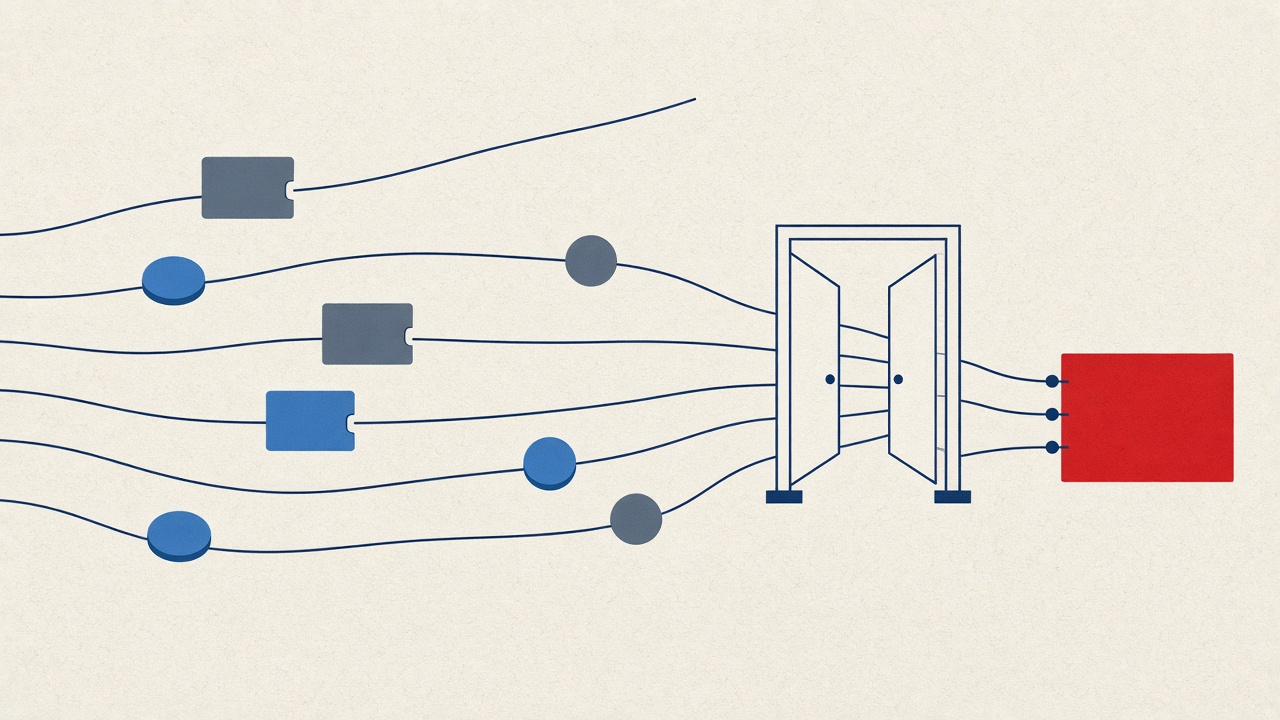
The argument in brief
- In many integrated SMB platforms (Square, Toast and Clover among them), the software, hardware and payment processing are sold as one package. When one line reads $0, the cost has moved to another line — usually the processing rate or the contract term.
- That is a legitimate business model. The problem is that buyers compare the visible number (monthly software fee) and ignore the ones that compound (basis points on every card sale, early-termination fees, hardware that only works with one processor).
- Our recommendation: model every shortlist over the contract term at your real card volume, and treat processor choice and exit terms as priced features, not fine print.
Allegations, not findings — but a useful warning
On October 29, 2026, the Federal Trade Commission, seven state attorneys general and two California local authorities sued Toast in federal court in San Francisco (N.D. Cal. No. 3:26-cv-12705).3, 4, 8 The complaint alleges, among other things, that Toast’s “$0” pricing was misleading, that customers faced hidden and unauthorized fees and add-ons, that support promises were not met, and that cancellation was unduly difficult. Much of the complaint concerns Toast’s “Pay-as-you-Go” plan, which, the complaint says, is presented to customers as “$0 for hardware and software but higher card transaction fees.” It alleges that such customers must pay the full retail value of the hardware if they do not start processing payments within 120 days, pay $85 a month during temporary closures, and, if they cancel, “are required to pay an ETF [early termination fee] of $150 per month for each remaining month of their contract” — a fee the complaint says is not disclosed — all allegations in the complaint.3, 4
Toast says it “strongly disagree[s] with the allegations” and will defend itself. It argues that the Restore Online Shoppers’ Confidence Act, one of the laws the FTC invokes, should not apply to “negotiated business-to-business agreements,” and says “nothing about today’s news changes our customer service, pricing, or support.”5
These are allegations in a pending case. No court has ruled on them, and we draw no conclusion about whether Toast broke the law. As of Nov. 5, 2026, a public docket listing showed the complaint, a sealing motion and a case-management order, with an initial conference set for Jan. 28, 2027, before Magistrate Judge Thomas S. Hixson; no answer or motion to dismiss appeared.8 We cite the case for a narrower reason: the complaint is a detailed public catalogue of where the cost of an integrated POS contract can sit when the headline price is zero. Those mechanisms exist across the industry, not only at one vendor.
A smaller case makes the same point from the processing side. On November 2, 2026, Washington’s Attorney General announced a settlement, with the FTC, with Riverside Payments and its affiliate Cascade Equipment Leasing. The complaint alleged promised savings that did not materialize, a buried $695 early termination fee, equipment leases and a “complicated loop of deflection” when merchants tried to cancel. The release describes a $32 million judgment suspended after a $600,000 payment, and a proposed order filed in the U.S. District Court for the Western District of Washington that would let affected merchants exit their processing agreements without a termination penalty for 60 days.7 (Settlement terms are per the Washington Attorney General’s announcement; the defendants’ position is not described in that release.)
Where the money actually goes
Look at how vendors themselves present pricing. Square’s US pricing page, accessed today, shows three plans:1
| Square plan (vendor pricing, US) | Monthly fee per location | In-person card rate |
|---|---|---|
| Square Free | $0 | 2.6% + 15¢ |
| Square Plus | $49 | 2.5% + 15¢ |
| Square Premium | $149 | 2.4% + 15¢ |
This is unusually transparent, and it illustrates the trade cleanly: Square charges less per transaction to merchants who pay more per month. The arithmetic (ours, using only Square’s published numbers and ignoring the feature differences between plans) is simple:
- 0.1 percentage points (Free → Plus) on $49,000 of monthly in-person card volume equals $49, which is Plus’s monthly fee ($49,000 × 0.001 = $49). On processing alone, Plus is always cheaper. Below that volume, Square Free is cheaper once Plus’s $49 monthly fee is counted; above it, Plus is.
- 0.2 points (Free → Premium) on $74,500 of monthly volume equals $149.
A business doing $150,000 a month in card sales pays about $150 more each month in processing on Square Free than on Square Plus ($150,000 × 0.001 = $150) — about $101 a month (~$1,200 a year) net of Plus’s $49 fee — before counting any of Plus’s features. That is not a criticism of Square; it is a demonstration that the processing rate is the price, and the monthly fee is only the dial that sets it.
Toast’s pricing page describes its “Pay-as-you-Go” option as one that “reduces your upfront hardware and installation costs through an all-in-one platform rate,” and states that its services “may only be used on approved Toast hardware.”2 Toast does not publish its rates on that page; prospective customers have to obtain a quote. Again: a legitimate design, but one that moves the cost into a rate the buyer must ask for.
Lock-in has three layers
“Can I switch processors?” is the wrong question, because the answer is often “technically yes, practically no.” Buyers should evaluate three separate layers:
- Contract lock-in. Term length, auto-renewal, early-termination fees, liquidated damages and minimum processing volumes. The FTC’s allegations about Toast and the Riverside settlement both turn on this layer.3, 4, 7
- Hardware lock-in. Devices that only run one vendor’s software, or that are provisioned to one processor, lose most of their value when you leave. Toast says its services run only on approved Toast hardware.2 Clover says its devices, even when bought or leased from third parties, “cannot be used with other payment processors.”9 (Some reseller sources go further and say a device is tied to the specific processor that boarded it; the Clover documentation cited here does not say that.)
- Data and integration lock-in. Menu, item, customer, loyalty and gift-card balances, and historical sales data. If you cannot export them in a usable format — and if your online ordering, loyalty and payroll are all the same vendor’s add-ons — the real switching cost is re-implementation, not hardware.
Integrated platforms can be the right choice. A single vendor for software and payments means one support line, faster funding, and fewer reconciliation problems. Many operators rationally accept lock-in for that simplicity. The point is to accept it knowingly and at a price you have modeled.
The tradeoff, stated plainly
| Model | You gain | You give up |
|---|---|---|
| $0 software, bundled processing | Low upfront cost; one vendor | Higher effective rate; little leverage at renewal; exit costs |
| Paid software, bundled processing at a lower rate | Lower cost at volume | Monthly commitment; still one processor |
| Software with processor choice (“payment-agnostic”) | Negotiating leverage; ability to switch processing without replacing POS | More vendors to manage; often higher software fees; integration risk |
| Interchange-plus pricing (where offered) | Visibility into card-network costs | Harder to forecast; more complex statements |
There is no universal winner. A seasonal food truck doing $8,000 a month may be best served by the $0 plan. A three-unit restaurant group doing $400,000 a month across locations is almost certainly overpaying if it never priced the alternatives.
What to do before you sign
- Model the term, not the month. Multiply your expected monthly card volume by the effective rate (including per-transaction fees), add all fixed fees and add-ons, and project across the full contract term. Do it for each shortlisted vendor.
- Ask for the processing rate in writing for each card-present, keyed-in, online and card-on-file transaction type, plus any international-card and chargeback fees. Square, for example, publishes a separate rate for manually entered payments (3.5% + 15¢) and an additional 1.5% international card fee.1
- Get the exit terms in writing: early-termination fee formula, hardware return or buyout obligations, data-export format and timeline, and what happens to gift-card liabilities.
- Ask whether the software can run with a different processor, and at what software price. If the answer is no, treat that as a cost and negotiate the rate accordingly.
- Ask what is auto-enrolled. Inventory every add-on on the order form and confirm each is opt-in.
- Re-shop at renewal. Your leverage is highest before auto-renewal.
Who this argument does not apply to
Very small, low-volume or seasonal sellers may never reach the volume at which a paid plan or a payment-agnostic platform pays off, and they may value the absence of upfront cost above everything else. Large enterprises typically negotiate custom processing and rarely see list prices. Our argument is aimed at the middle: established independents and small multi-unit operators whose volume has grown since they first signed.
What would change our mind
- If independent data showed that merchants on bundled “$0” plans pay effective total costs (all fees over the full term) comparable to or lower than merchants on paid or payment-agnostic plans at similar volume, our framing would be overstated. We have not found such data; nor have we found the opposite. This is a gap, and a survey of real statements (with consent) would be worth commissioning.
- If the FTC case against Toast were dismissed on the merits rather than on the ROSCA question, that would weaken the use of the complaint as an illustration — though not the arithmetic above.
- If major integrated platforms began publishing processor-choice options and standardized exit terms, the lock-in concern would shrink substantially.
Sources
-
Square, US pricing page. https://squareup.com/us/en/pricing (vendor pricing; accessed 2026-11-16)
-
Toast, pricing page and FAQ. https://pos.toasttab.com/pricing (vendor pricing; accessed 2026-11-16)
-
Federal Trade Commission, “FTC and States Take Action Against Toast Inc. over Hidden and Unauthorized Fees, Deceptive Subscription and Cancellation Practices and Other Unlawful Conduct,” Oct. 29, 2026. https://www.ftc.gov/news-events/news/press-releases/2026/10/ftc-states-take-action-against-toast-inc-over-hidden-unauthorized-fees-deceptive-subscription (government; allegations; ftc.gov returns a 404 bot-block page to automated requests; the URL is unchanged — open in a browser). Primary link for the allegations: the complaint PDF, https://www.ftc.gov/system/files/ftc_gov/pdf/Toast-Redacted-Complaint-Filed.pdf. Backup release: Illinois Attorney General, Oct. 29, 2026, https://illinoisattorneygeneral.gov/news/story/attorney-general-raoul-files-lawsuit-against-toast-inc-over-hidden-and-unauthorized-fees-deceptive-subscription-practices-and-other-unlawful-conduct
-
FTC et al. v. Toast, Inc. et al., No. 3:26-cv-12705 (N.D. Cal.), redacted complaint. https://www.ftc.gov/system/files/ftc_gov/pdf/Toast-Redacted-Complaint-Filed.pdf (court filing; allegations)
-
Toast, “Toast responds to FTC lawsuit,” Oct. 29, 2026. https://pos.toasttab.com/news/toast-responds-ftc-lawsuit (company statement)
-
Nation’s Restaurant News / Restaurant Business, Oct. 29, 2026. https://www.nrn.com/restaurant-technology/toast-is-sued-by-the-ftc-over-alleged-hidden-fees-24-7-support-claims (independent reporting)
-
Washington State Attorney General, Nov. 2, 2026. https://www.atg.wa.gov/news/news-releases/wa-ftc-reach-600k-settlement-payment-processing-company-deceptive-practices (government; settlement)
-
Justia docket, FTC v. Toast. https://dockets.justia.com/docket/california/candce/3:2026cv12705/482344 (docket)
-
Clover, “Clover support for new and existing customers” / POS FAQs. https://www.clover.com/deals/customer-service/ (vendor documentation; accessed 2026-11-16)